GraniteShares moved the effective date of a registration amendment covering its proposed 3x Long XRP Daily ETF and 3x Short XRP Daily ETF from Nov. 30 to Dec. 31, 2026. Its Nov. 27 filing with the U.S. Securities and Exchange Commission also covers six proposed funds tied to Bitcoin, Ether and Solana. Dec. 31 is not a launch date: neither XRP fund has begun trading, and the filing does not say when trading would start.
The underlying registration dates to an amendment filed on Oct. 7, 2025. GraniteShares said the sole purpose of its Oct. 26, 2026 filing, which set the Nov. 30 date, was to delay the amendment. The registration may still change before the funds trade.

What the funds would track
The long fund would seek three times XRP’s daily percentage return, while the short fund would seek minus three times that return, both before fees and expenses. According to its summary, the short fund would use cash-settled swaps, futures and options rather than hold XRP. U.S. investors already have access to 2× daily XRP products, including ProShares’ UXRP, Teucrium’s XXRP and Volatility Shares’ XRPT.
The word daily matters because each fund would reset its exposure every day. Consider a hypothetical two-day move from $0.90 to $0.95 and back to $0.90. The table starts each position at $1,000 and assumes both funds meet their daily targets exactly, excluding fees, financing costs and tracking differences.
| Position | Day 1: XRP at $0.95 | Day 2: XRP back at $0.90 |
|---|---|---|
| Spot XRP | $1,055.56 | $1,000.00 |
| 3× daily long | $1,166.67 | $982.46 |
| 3× daily short | $833.33 | $964.91 |
The spot position breaks even. The long fund loses about 1.8% because the second day’s decline applies to a larger balance. The short fund loses about 3.5% because its second-day gain applies to a smaller balance. These are illustrative results, not fund performance. The SEC’s investor bulletin on leveraged and inverse ETFs warns that returns over periods longer than a day can differ sharply from the stated multiple. Repeated reversals can widen the gap, while a sustained move can compound gains for the fund positioned in that direction.

XRP’s range ahead of the Nov. 30 weekly close
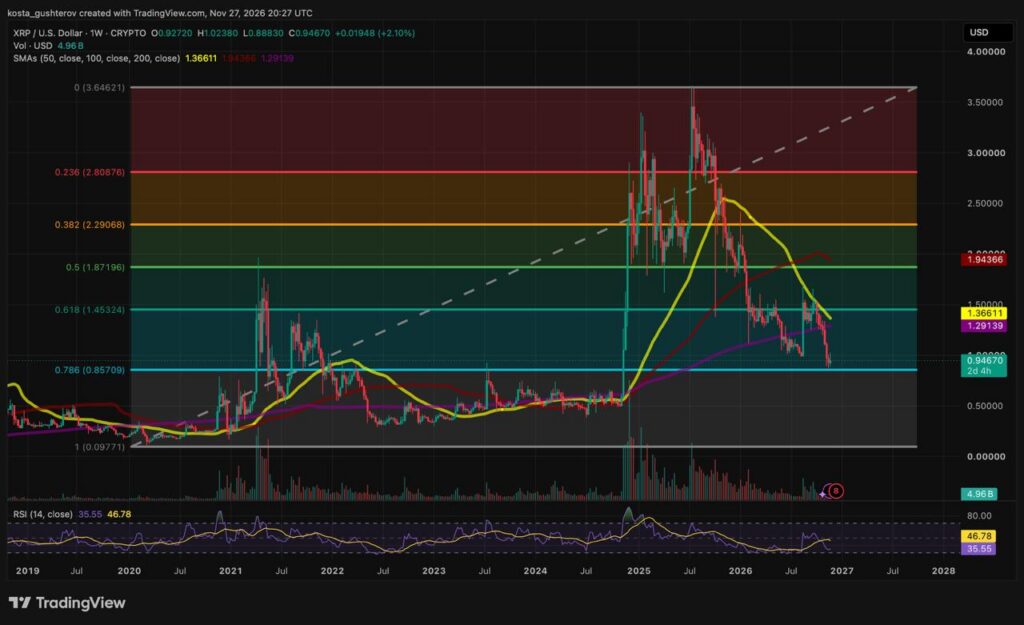
The hypothetical round trip was smaller than XRP’s observed weekly swing. XRP opened the week near $0.93, reached $1.02 on Nov. 23 and gave back the spike in the same session. It then fell to $0.89 before recovering to about $0.95. On the Nov. 27 TradingView chart, XRP was up roughly 2% for the unfinished week on turnover of about $4.96 billion. Its weekly relative strength index (RSI), a momentum indicator, stood at 35.55, below its 46.78 average.
Coindoo’s Nov. 25 analysis identified buying near $0.86 and stalled rebounds near $1.02. The longer-term chart showed lower highs since XRP’s $3.65 peak in 2025. XRP fell below its 200-week moving average around midyear, recovered it in August and lost it again in November. At about $0.95, XRP was roughly 27% below that average of $1.29. The falling 50-week average stood at $1.37, and a retracement level near $1.45 added another potential barrier.
For the weekly close at 00:00 UTC on Nov. 30, Coindoo outlined three conditional readings rather than forecasts:
- If $0.86 held: A rebound toward $1.15–$1.30 would retest the 200-week average from below. A rejection there would be consistent with a broad $0.70–$1.25 range when intraweek swings were included.
- If XRP closed below $0.86 on heavier volume: The prior trading range’s ceiling near $0.75 would be the next reference point, followed by the 2024 base at $0.55–$0.70.
- If XRP closed above $1.29: Reclaiming the 200-week average would weaken the bearish reading. A further move above $1.37 and $1.45, with weekly RSI back above 50, would bring $1.87–$1.94 and the retracement near $2.29 into view.
A single weekly close had not settled XRP’s direction in earlier moves across the 200-week average. For the proposed ETFs, the distinction is more basic: even knowing where XRP ends a week is not enough to calculate either fund’s return without knowing its daily moves.