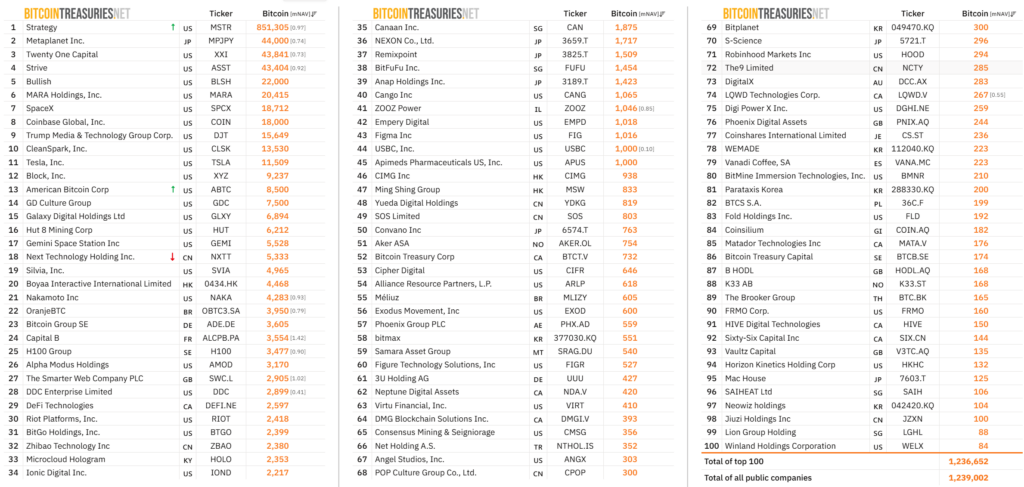
MicroStrategy chairman Michael Saylor argued on November 27, 2026, that Bitcoin need not replace the dollar at the checkout to compete for Americans’ savings. He and Strive CEO Matt Cole were responding to economist Jeffrey Tucker, who argued that an asset must be used in exchange to qualify as money. The two executives’ companies held about 894,700 BTC between them, giving shareholders exposure to Bitcoin through their stock.
Paying in dollars, saving in Bitcoin
“There is no such thing as money that is not used in exchange,” wrote Tucker, founder of the Brownstone Institute. He argued that monetary history offered no precedent for Bitcoin advocates’ belief that they could will a store of value into existence and make it the world’s most valuable asset. An early Bitcoin promoter, Tucker has said he lost confidence in the network after the 2015–2017 dispute over how many transactions it should handle, according to a Brownstone episode description.
Saylor drew a distinction between what people spend and what they keep. “Jeffrey, a gold-backed banknote could pay the baker, the miller, and the farmer while the gold stayed in the vault. Today people pay in dollars and save in gold, stocks, and real estate. Bitcoin is competing for those savings.” The historical analogy concerned the role of reserves: notes circulated while the metal backing them did not. The dollar’s fixed link to gold ended in 1971, when President Richard Nixon ended dollar convertibility into gold.
Cole turned Tucker’s wording back on defenders of the dollar. He argued that the US could not finance deficits by printing money and count on the dollar remaining the world’s reserve currency indefinitely. US public debt exceeded $40 trillion for the first time in August 2026, according to Treasury data. The dollar retained its reserve status: it accounted for 56.7% of central banks’ foreign exchange reserves in the second quarter of 2026, according to the International Monetary Fund.
What the savings argument means for shareholders
Bitcoin Treasuries ranked MicroStrategy first among public Bitcoin treasury companies with 851,305 BTC and Strive fourth with 43,404 BTC. The tracker counted 196 public companies holding about 1.24 million BTC in total. Their treasury model depends on holding Bitcoin rather than spending it.
The two companies took different approaches as Bitcoin’s price fell in November: Strive continued adding BTC, while MicroStrategy slowed its purchases. MicroStrategy’s filing put its average purchase price at $75,456 per coin as of early November. By the time of the exchange, Bitcoin had fallen below that figure, leaving the holding at an unrealized loss. MicroStrategy shares had also lost nearly half their value over the preceding year.