Originally reported by The Block on November 8, 2026, at 23:51 (UTC+8). Ethereum co-founder Vitalik Buterin argued that ETH’s value should rest primarily on Ethereum’s durability as a decentralized network, rather than on how much ETH transaction fees destroy.
EIP-1559 is not in question. The 2021 upgrade burns part of every transaction fee, and Buterin said Ethereum should keep it. But holders “should not feel sad” if that burn remains below 10% of the level needed to offset new ETH issuance indefinitely. In his view, pursuing substantially more burn could require sustained protocol funding and interventionist governance, while higher gas prices could exclude users who need privacy and security.
Buterin challenged the idea that fee revenue provides a reliable valuation floor. He gave an illustrative calculation: $1 billion in annual burn divided by a 4% discount rate suggests a $25 billion valuation. But he said much of Ethereum’s 2021–2023 burn came from crypto activity that might shrink alongside ETH’s price. He cited a single-day fee spike of $180 million during the Otherdeed digital-land sale. According to The Block’s data, Ethereum burned about 1.48 million ETH in 2022, compared with about 19,200 ETH so far in 2026 as of the report.
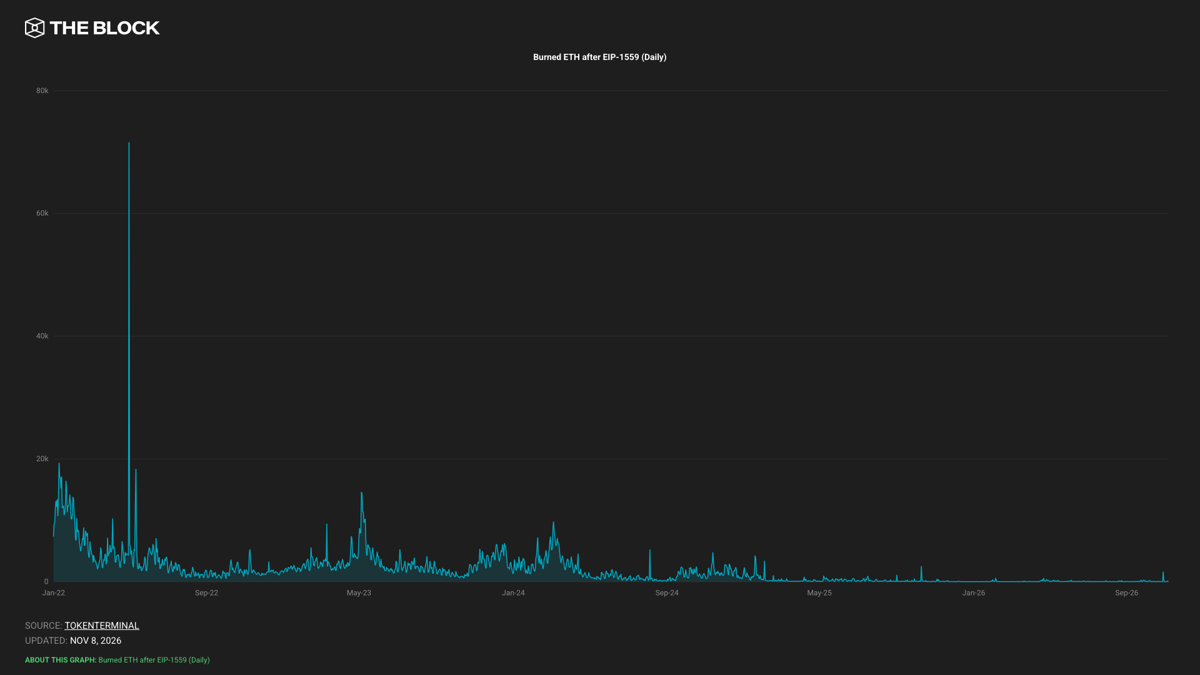
Using an ETH market capitalization of roughly $270 billion, Buterin also argued that supporting a fee-burn-based valuation on the scale of a large company could demand spending Ethereum’s institutions could not readily sustain. His comparison implied about 700,000 ETH a year in protocol funding and a two-thirds reduction in validator revenue; it was an argument about the costs of that approach, not a funding proposal or an enacted rule.
Instead, Buterin emphasized survival, decentralization, censorship and capture resistance, open source, privacy and security. He pointed to work including lightweight nodes and FOCIL, a censorship-resistance proposal. Separately, EIP-8363—a proposal to burn an increasing share of validator rewards as more ETH is staked—had been withdrawn from consideration for the forthcoming Hegota upgrade after opposition. Its authors planned a separate issuance discussion through EthCC in April. Neither that proposal nor Buterin’s store-of-value argument represents an activated protocol change.
Source: theblock.co (originally published 2026-11-08 23:51 UTC+8)