
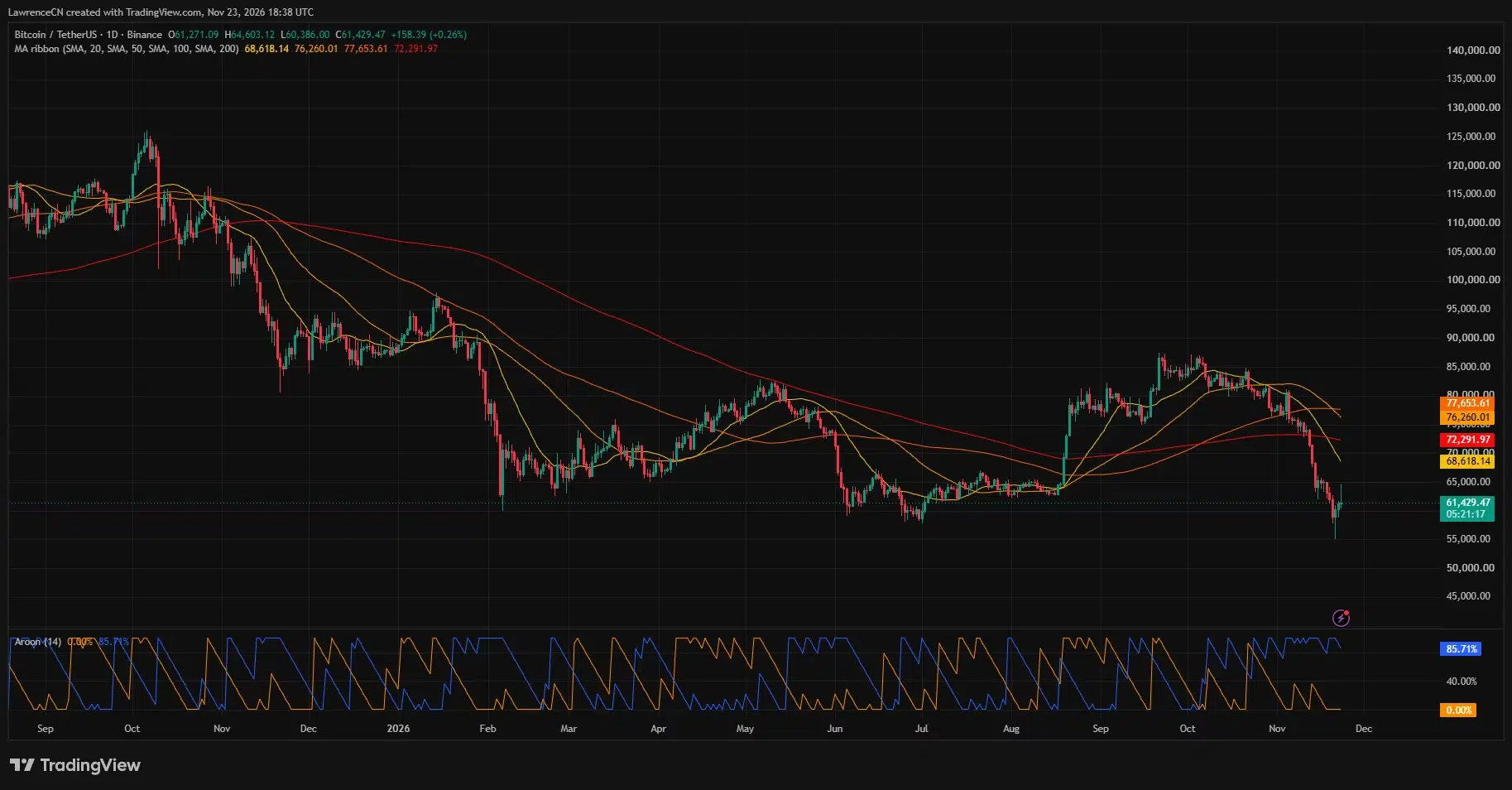
As of Nov. 24, 2026, Bitcoin had given back most of its Nov. 23 gain. After trading near $55,100 on Nov. 21, it reached $64,603 on Nov. 23 before retreating toward $61,500. At 18:38 UTC on Nov. 23, Binance BTC/USDT data on TradingView put the price at $61,429, about 4.9% below the intraday high and just 0.26% above the day’s open. Bitcoin was still about 24% below the $81,000 area it had traded near in late October.
ETF withdrawals were concentrated late in the week
Farside Investors’ daily totals showed $4.137 billion in net withdrawals from US spot Bitcoin ETFs over the first 15 November trading sessions through Nov. 20. The funds recorded outflows in 13 sessions. Nov. 4 and Nov. 16 were the only days with net inflows.

A $7.9 million inflow on Nov. 16 was followed by four consecutive sessions of withdrawals, bringing net outflows for the week to $1.79 billion. Investors withdrew a net $1.25 billion on Nov. 19 and 20 alone, roughly 30% of the month’s total through Nov. 20. BlackRock’s iShares Bitcoin Trust accounted for $544.7 million of the $669.2 million that left the funds on Nov. 20, after recording $541.1 million in outflows the previous day.
Why traders saw short covering rather than fresh demand
Trader Ardi attributed most of the Nov. 23 rebound to traders buying back short positions. He said aggregate open interest, the number of outstanding derivatives contracts, had fallen roughly 10% from its recent peak and continued to decline as Bitcoin rose. Buying to close shorts can lift prices even as the number of open contracts falls.
Ardi noted some improvement in cumulative spot volume delta, which tracks the running difference between aggressive spot buying and selling. But the measure was still making lower highs and lower lows. He said higher highs in that measure, accompanied by rising prices and open interest, would be more persuasive evidence of fresh buying. Daan Crypto Trades, who had identified $62,000 as a level buyers needed to hold heading into the US market open, said spot demand was insufficient to sustain the rally once the squeeze ended.
The preceding weekend sell-off had liquidated an estimated $2.7 billion in leveraged positions across crypto markets, according to crypto.news. In a Nov. 23 note, trading firm QCP said hedging and thin weekend trading may have contributed to Bitcoin’s drop toward $55,000. QCP noted that Bitcoin had subsequently recovered during Asian trading hours even as Nasdaq futures fell.
Chart levels after the pullback
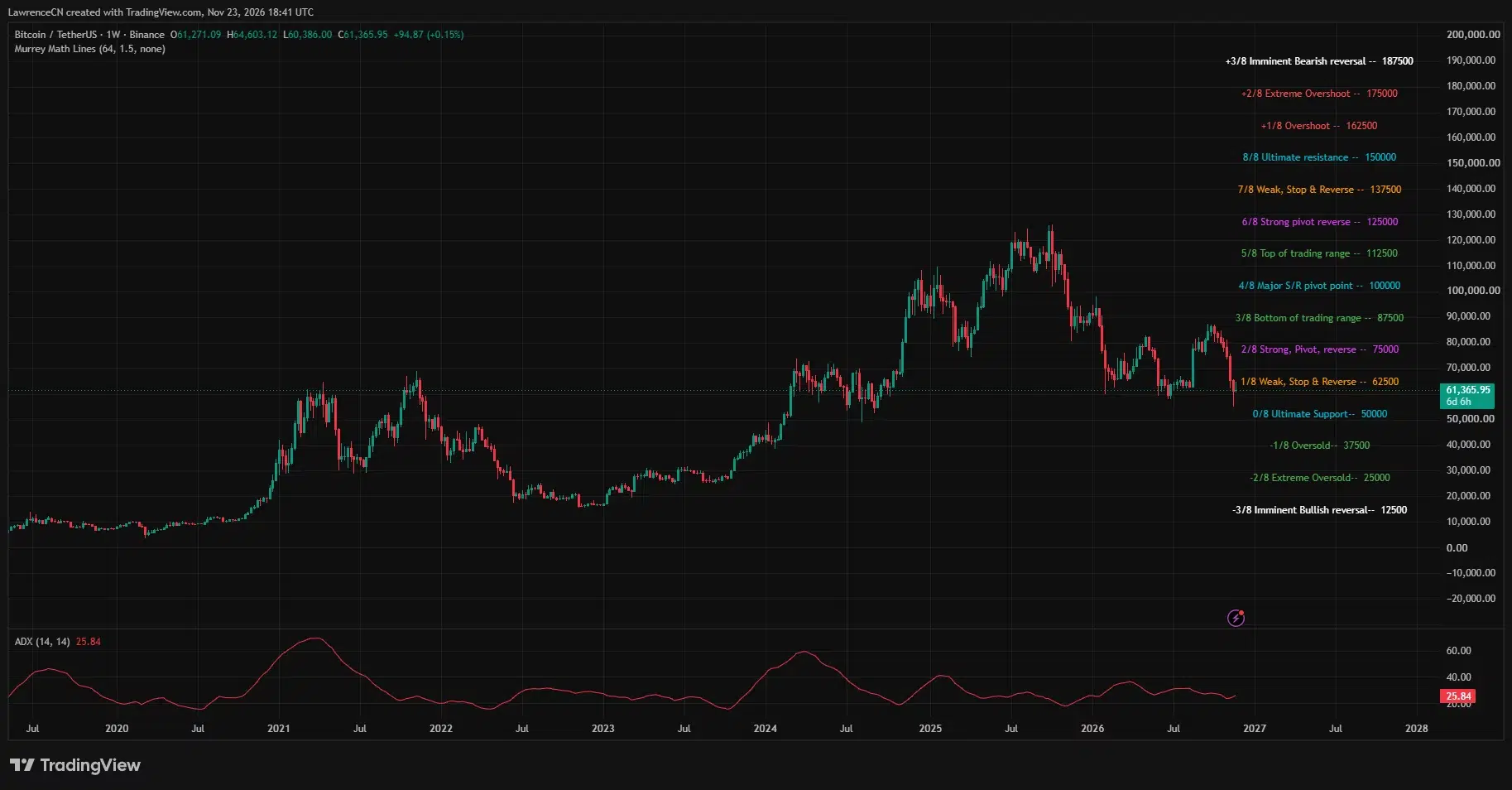
Bitcoin briefly crossed the weekly chart’s $62,500 Murrey Math level on Nov. 23 before falling back below it. The indicator’s next lower line was $50,000, below the Nov. 21 low near $55,100. Weekly ADX, which measures trend strength rather than direction, stood at 25.84.
On TradingView’s daily chart, Bitcoin remained below its 20-, 50-, 100- and 200-day simple moving averages. The closest was the 20-day average at $68,618, followed by the 200-day average at $72,292. Aroon Down stood at 85.71% against 0% for Aroon Up, indicating that the period’s low was more recent than its high.
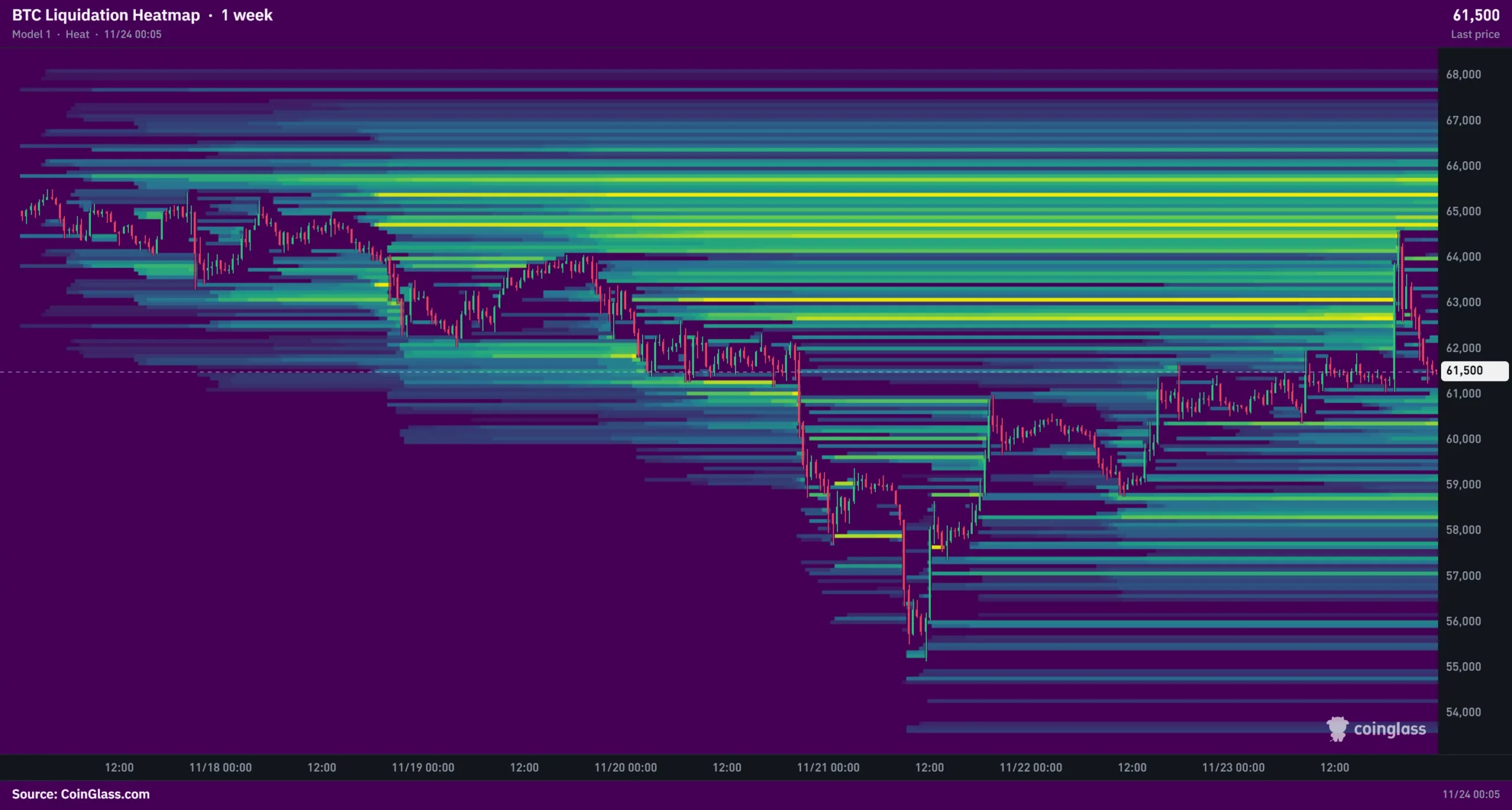
With Bitcoin near $61,500, CoinGlass’s seven-day heatmap showed the nearest liquidation bands above the price at $62,600–$63,000. Denser bands appeared at $64,700–$65,700, just above the Nov. 23 high. Below the day’s Binance low of $60,386, a cluster remained visible near $58,300, an area Bitcoin had crossed in both directions over the weekend. The bands estimate where leveraged positions could be liquidated if the price reaches those levels; they do not represent confirmed liquidations.