
A draft Ethereum consensus-layer proposal, EIP-8502, would introduce a per-epoch balance deduction to encourage operators to consolidate smaller validators. Researcher Anders Elowsson submitted the draft to an Ethereum repository, according to a November 19, 2026, report by TechFlow. The proposal is not an activated network rule.
The draft addresses a scaling problem for consensus communication: signature-processing costs rise with the number of active validators, not simply with the amount of ETH staked. TechFlow reported approximately 815,000 active validators and 44.01 million ETH staked as of November 19, with an average effective balance of about 54 ETH per validator. The already activated EIP-7251 allows voluntary consolidation, but EIP-8502’s premise is that an economic incentive is also needed.
Under the draft, the deduction would vary with a validator’s effective balance and how far the network’s validator count exceeds a scheduled target. A validator at 32 ETH would face the highest rate—potentially as much as its full attestation reward in an extreme case. The rate would decline linearly as its effective balance increases, reaching zero at the 2,048 ETH maximum effective balance.
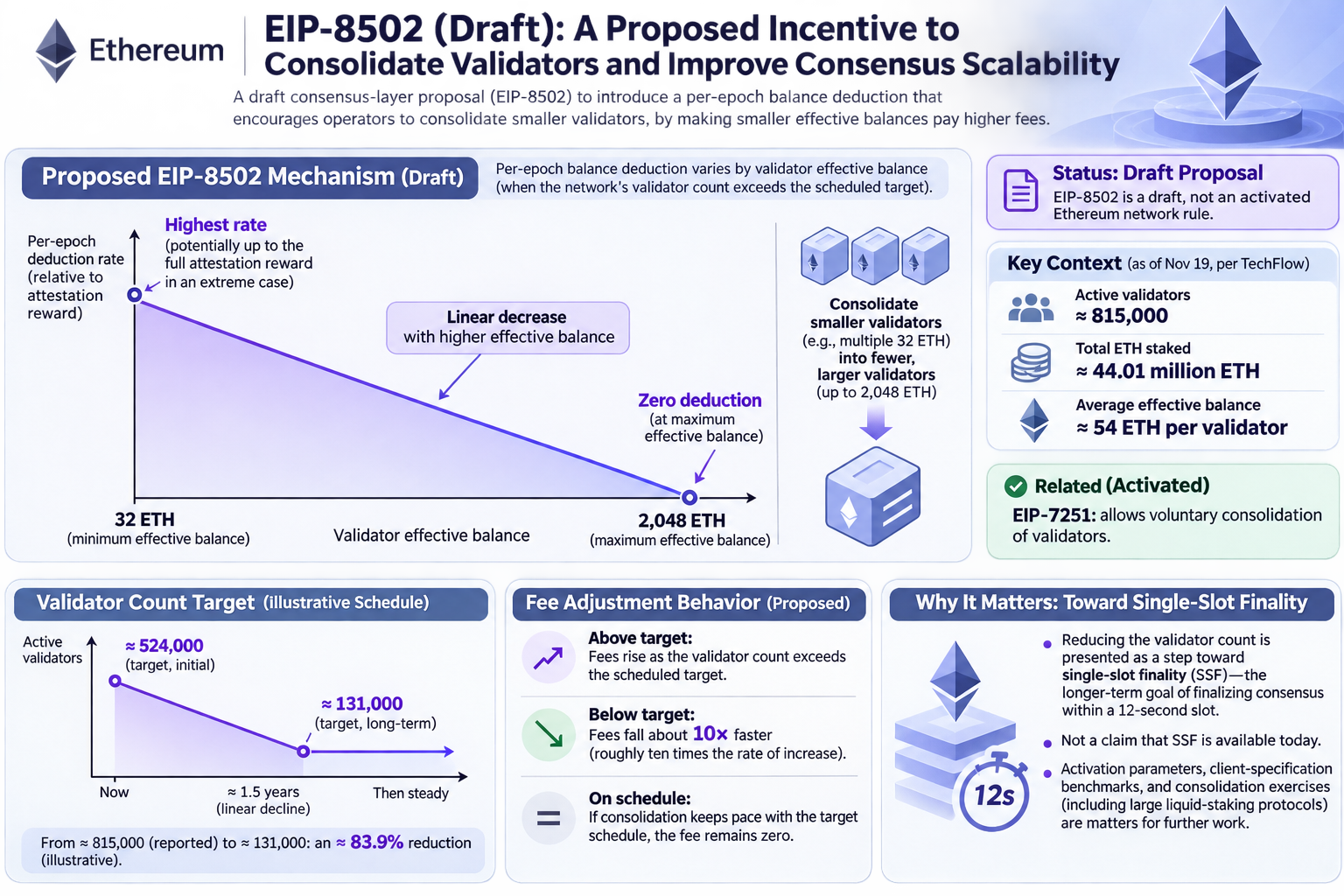
The draft uses illustrative targets that fall from about 524,000 active validators to about 131,000 over roughly 1.5 years, then remain steady. It describes the latter as an approximately 83.9% reduction from the roughly 815,000 validators reported at the time. Fees would rise as the count exceeds the scheduled target and fall about ten times faster when it drops below target; if consolidation keeps pace with the schedule, the fee would remain zero.
Reducing the validator count is presented as a step toward single-slot finality, the longer-term goal of finalizing consensus within a 12-second slot—not as a claim that this capability is available today. EIP-8502 remained a Draft in the November 19 report. Activation parameters, client-specification benchmarks and consolidation exercises involving large liquid-staking protocols were described as matters for further work.