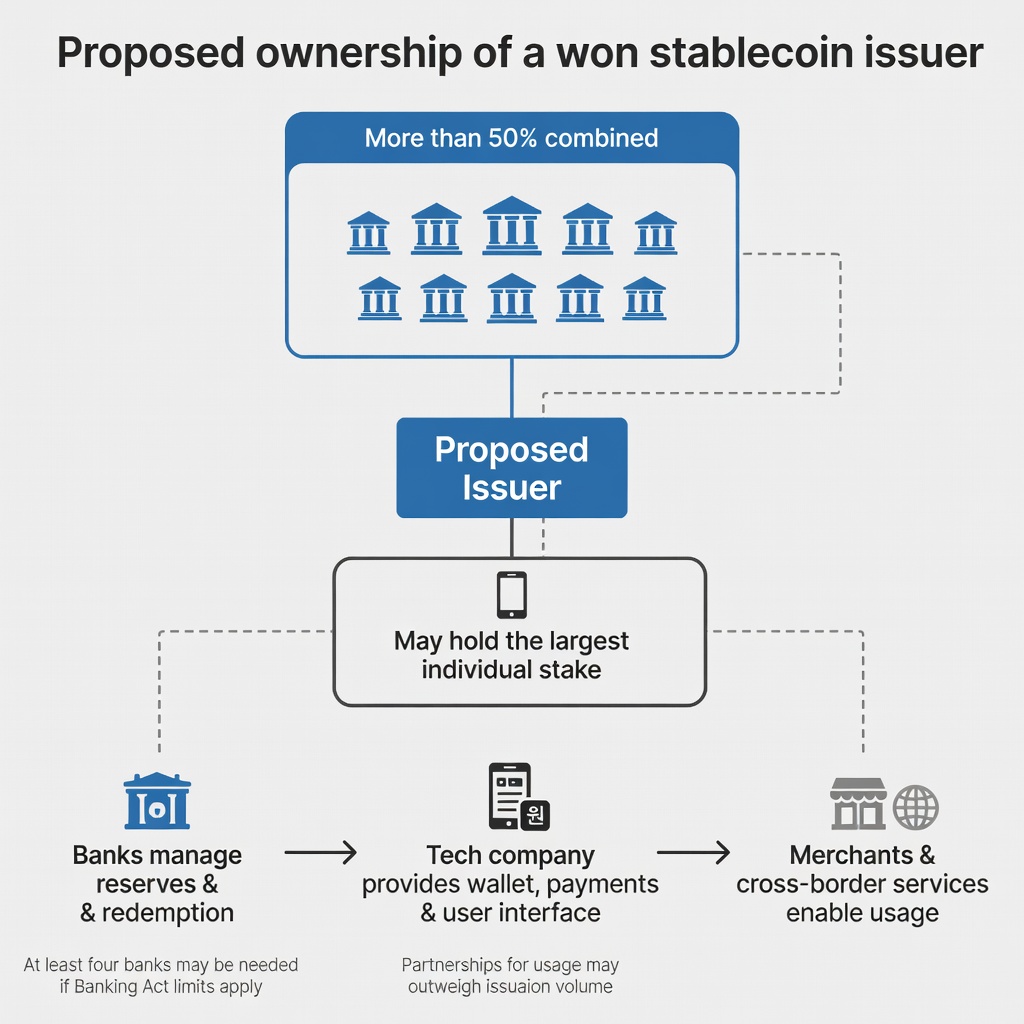
South Korea’s Financial Services Commission released a government draft on November 24, 2026, that would require banks to own more than 50% of each won stablecoin issuer collectively. A fintech or technology company could still be the largest individual shareholder. The distinction matters: banks could hold a majority between them while a payments company manages the wallet that customers use to pay merchants or send money abroad.
What the draft would require
Under the proposed Digital Asset Industry Innovation and User Protection Act, an issuer would need approval and at least 5 billion won in share capital. It would have to back its stablecoins fully with bank reserves, allow holders to redeem them at face value and pay no interest to holders.
The draft does not specify how many banks an issuing consortium would need. Tiger Research noted that the Banking Act limits a bank’s stake in a nonfinancial company to 15%. If that limit applies to stablecoin issuers, at least four banks would be needed to clear the proposed majority threshold. Implementing rules would need to clarify whether the cap applies and how consortium members would share decision-making authority.
Issuing a stablecoin and getting it used
Two tests in 2026 illustrate the different roles banks and payments companies could play. In May, KB Financial Group completed a won stablecoin pilot covering merchant payments and cross-border remittances. In July, fintech company Toss worked with Ethereum layer-2 network Optimism and blockchain development team Sunnyside Labs to test stablecoin payments for financial institutions.
KB’s pilot extended its banking capabilities into payments. Toss approached the same market with an existing app for transfers and payments. Even without a majority stake in an issuer, a platform serving both customers and merchants could influence which merchants, remittance channels and technical networks a consortium supports.
With interest payments prohibited under the proposal, issuers could not compete by offering holders a higher yield. Payment speed, conversion costs and merchant acceptance would give users more practical reasons to switch. Banks could manage reserves and redemption, while a wallet provider could earn transaction fees and retain a direct relationship with customers. Tiger Research judged that partnerships that help people use won stablecoins could matter more to the business than the volume issued.
Foreign stablecoins and the legislative timetable
The draft would also allow foreign stablecoins to circulate in South Korea if they meet the commission’s standards. The commission had not published those criteria as of November 25, 2026, so it was not yet possible to identify which foreign stablecoins would qualify. Local issuers could have an advantage in won-denominated purchases and bank account connections, while foreign stablecoins could offer broader cross-border liquidity. In either case, use would depend on support from wallets, exchanges, payment providers and merchants.
The bill still requires National Assembly review and presidential promulgation. Tiger Research estimated that it could take effect one year after promulgation; no effective date has been set.