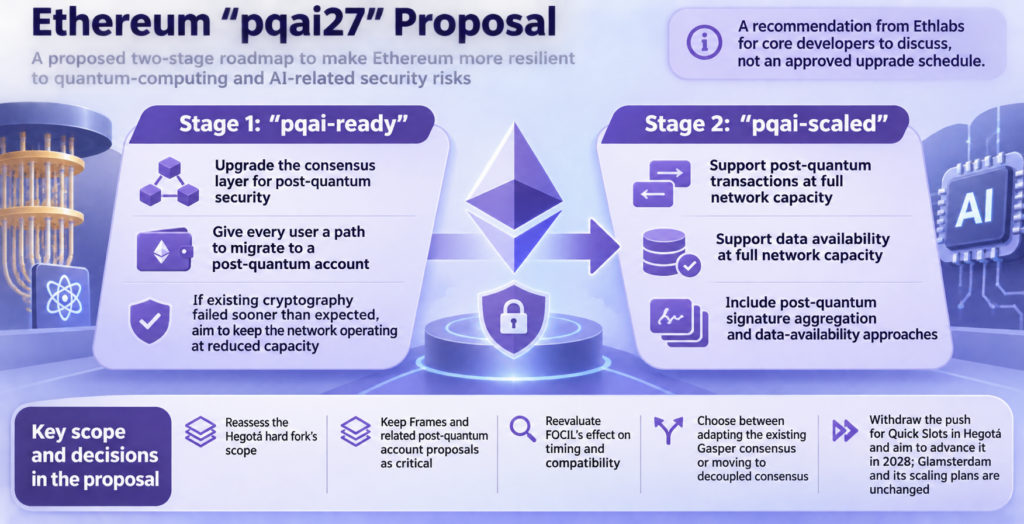
Ethlabs has proposed 2027 as a target for making Ethereum more resilient to quantum-computing and AI-related security risks. In a proposal reported on November 12, 2026, Ethlabs called the effort “pqai27.” It remains a recommendation for core developers to discuss, not an approved upgrade schedule.
Ethlabs argues that advances in quantum computing and AI-assisted software vulnerability discovery warrant earlier work on protocol security. It cited a shift in the U.S. government’s quantum-risk target from 2035 to 2030 and a Google plan to achieve post-quantum capability before 2029. Ethlabs also said there is no evidence that AI will necessarily break current cryptographic primitives, while arguing that the risks are difficult to predict.
The proposal sets out two stages:
- “pqai-ready” would upgrade Ethereum’s consensus layer for post-quantum security and give every user a path to migrate to a post-quantum account. If existing cryptography failed sooner than expected, the network would aim to keep operating at reduced capacity.
- “pqai-scaled” would support post-quantum transactions and data availability at full network capacity, with transaction throughput comparable to ordinary transactions. Ethlabs identifies post-quantum signature aggregation and data-availability approaches as part of that work.
To prioritize pqai27, Ethlabs suggests reconsidering the scope of the later Hegotá hard fork. It regards Frames and related post-quantum account proposals as critical, while calling for another assessment of FOCIL’s effect on timing and compatibility. Developers would also need to choose between adapting the existing Gasper consensus protocol and moving to decoupled consensus.
Ethlabs said it would withdraw its earlier push to include Quick Slots in Hegotá and seek to advance the feature in 2028 instead. It proposed no change to the planned Glamsterdam upgrade or its scaling plans. The roadmap and these scope decisions remain subject to discussion among Ethereum core developers.