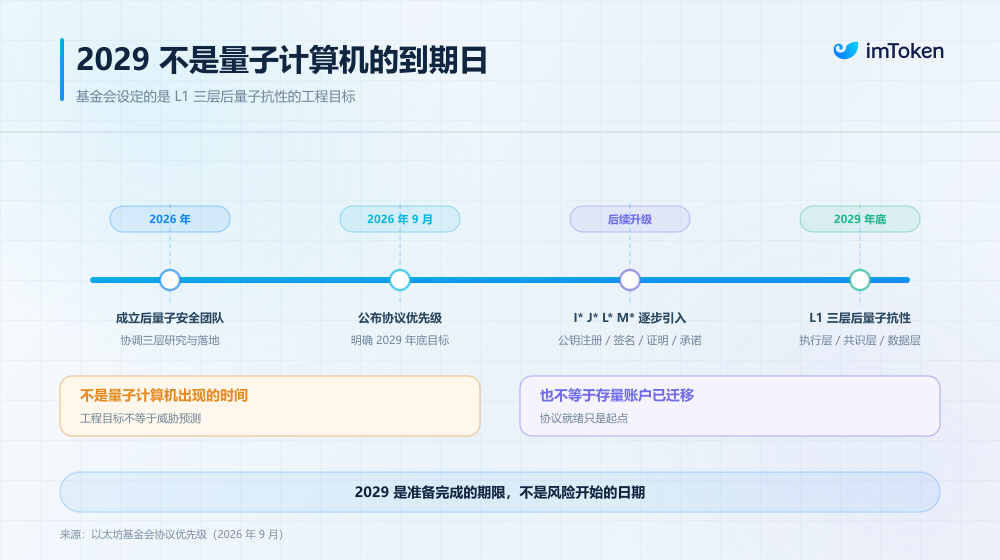
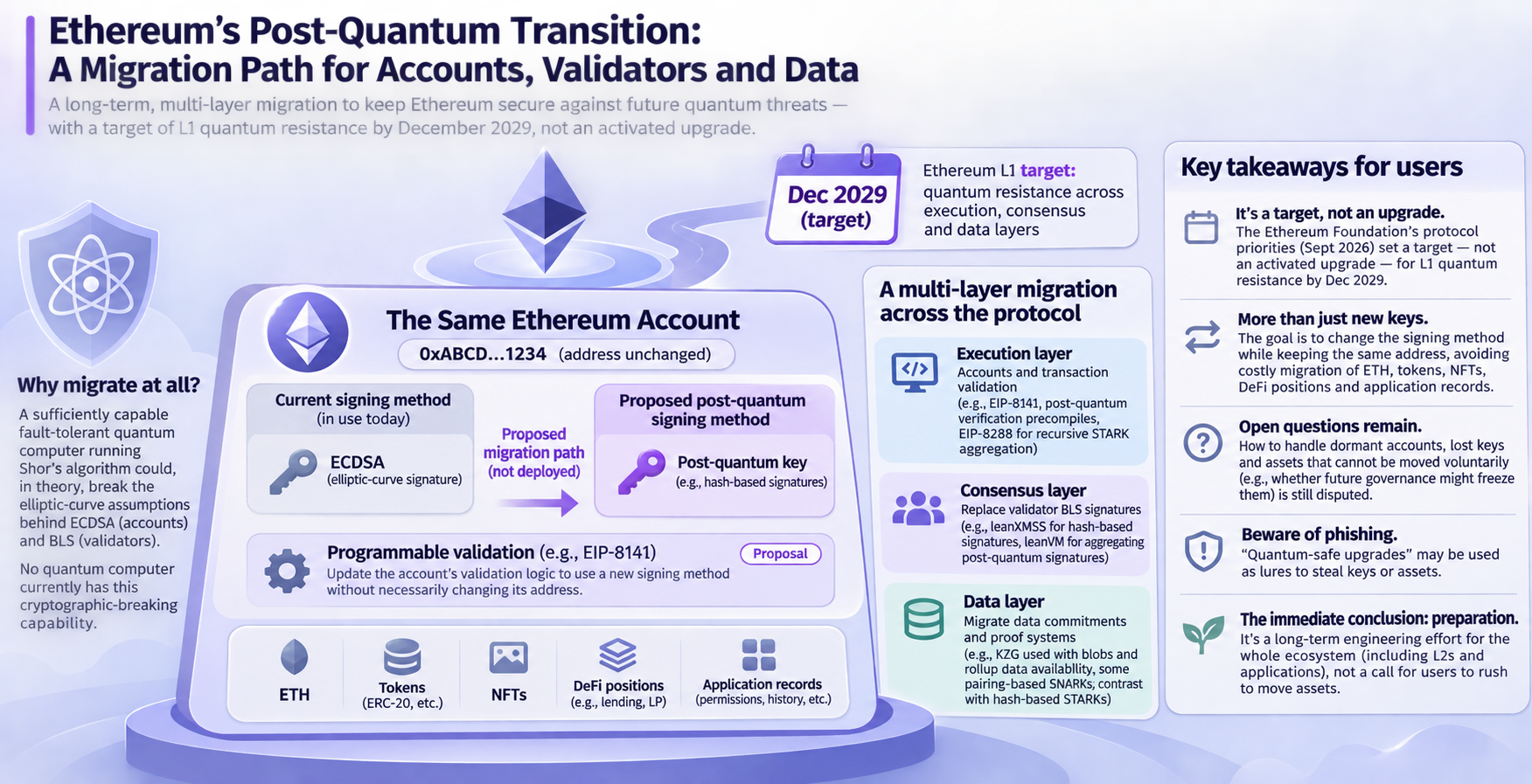
In an article published on November 18, 2026, imToken described Ethereum’s post-quantum work as a migration challenge spanning user accounts, validator signatures and data commitments. It reported that the Ethereum Foundation’s protocol priorities, published in September 2026, set a target—not an activated upgrade—of making Ethereum L1 resistant to quantum attacks across its execution, consensus and data layers by December 2029.
Why accounts need a migration path
A sufficiently capable fault-tolerant quantum computer running Shor’s algorithm could, in theory, undermine the elliptic-curve assumptions behind Ethereum accounts’ ECDSA signatures and validators’ BLS signatures. The article said no quantum computer currently has that cryptographic-breaking capability.
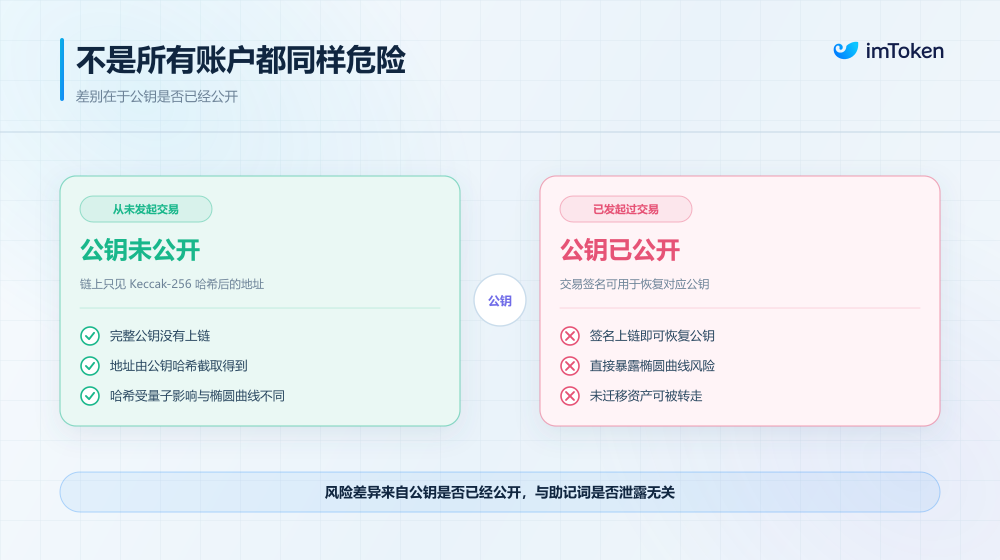
For a conventional externally owned account, an address is derived from a hash of its public key. An account that has never sent a transaction or disclosed a signature off-chain has not exposed its full public key in those ways. Once it signs a public transaction, the public key can be recovered from the signature, creating a different long-term risk if elliptic-curve cryptography is eventually broken.
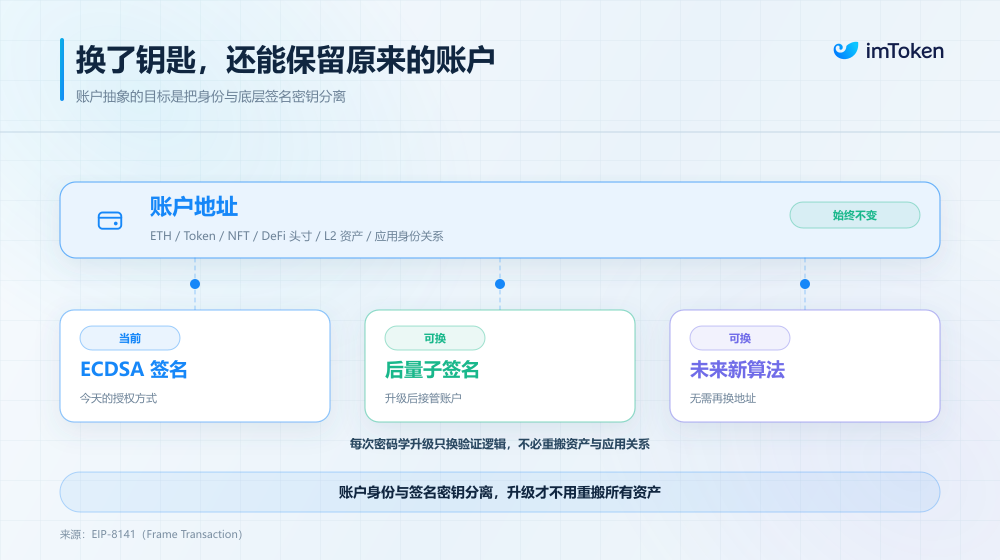
The proposed response is not simply to issue users new keys. Changing addresses could require moving ETH, tokens, NFTs and DeFi positions, while also disrupting application records tied to an address. EIP-8141, which the article discusses as a proposal for native account abstraction, would separate transaction validation, execution and gas payment. Programmable validation could provide a route to changing an account’s signing method without necessarily changing its address; that capability is not described as deployed.
The article also identifies post-quantum signature-verification precompiles as an area of study. It says EIP-8288 proposes using recursive STARK aggregation to reduce the on-chain burden of verifying larger post-quantum signatures. Neither proposal should be read as an already activated protection.
Consensus, data and unresolved choices
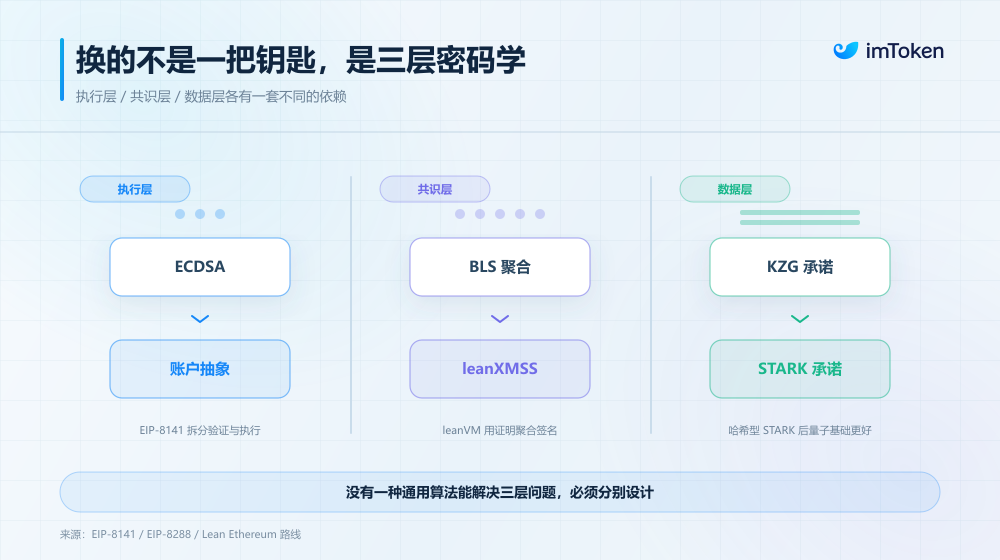
Replacing validators’ aggregate-friendly BLS signatures poses a different problem: larger signatures could increase network, storage and verification costs. The Lean Ethereum directions described in the article include leanXMSS, a hash-based signature approach intended to replace validator BLS signatures, and leanVM, intended to help aggregate post-quantum signatures into compact proofs.
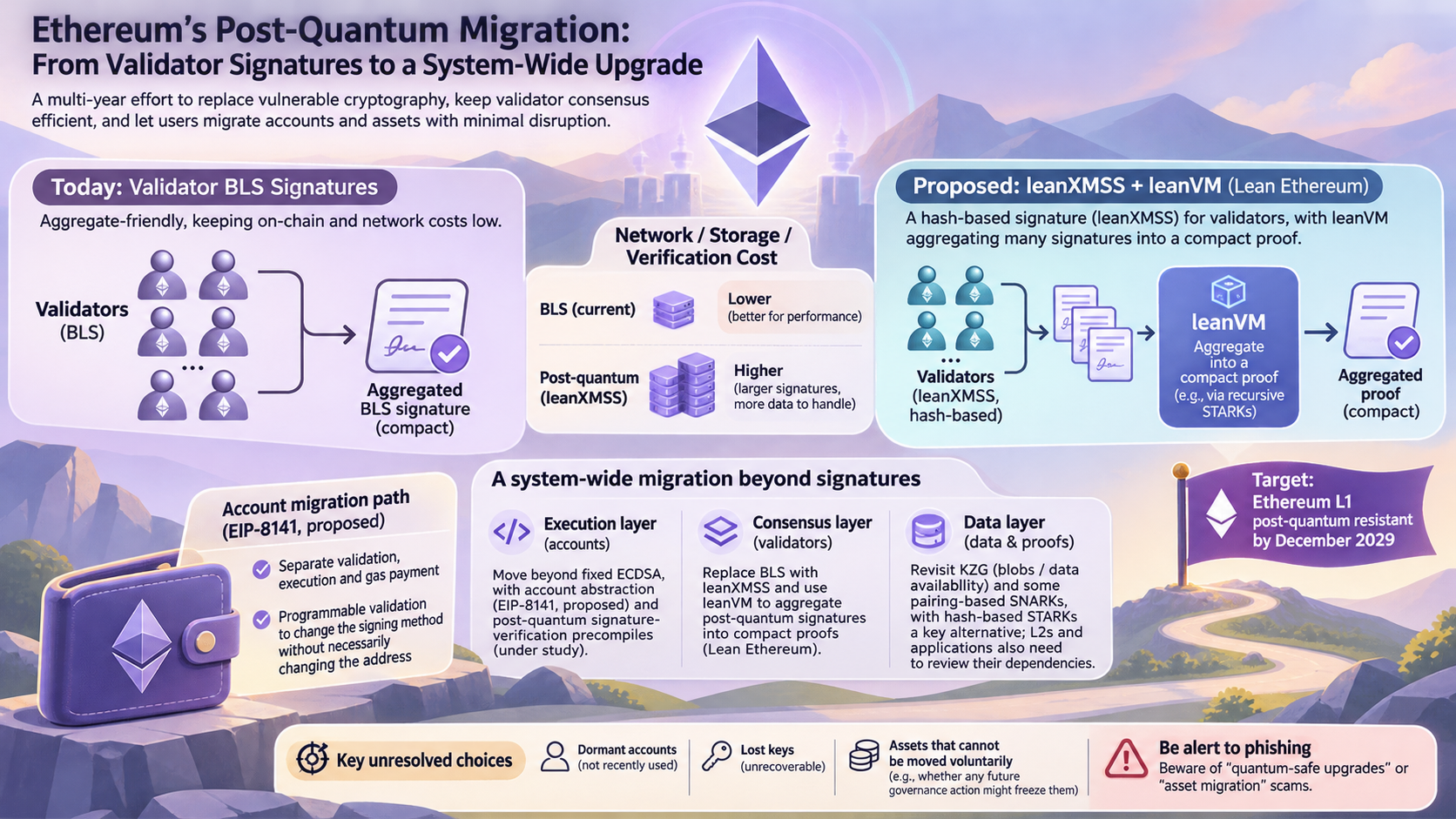
The migration also extends beyond signatures. KZG commitments used with blobs and rollup data availability rely on elliptic-curve-related assumptions, while some pairing-based SNARKs face similar concerns. The article contrasts these with hash-based STARKs and notes that L2s and applications would also need to consider their own cryptographic dependencies.

For users, timing remains consequential. A migration authorized with an existing key works only while that key can still reliably establish ownership. The article says what to do about dormant accounts, lost keys and assets that cannot be moved voluntarily—including whether any future governance action might freeze them—remains disputed. It also warns that purported “quantum-safe” upgrades could be used as phishing lures. Its immediate conclusion is preparation, not a call for users to rush to move assets.