
A working group announced on November 18, 2026, aims to advance Ethereum stealth addresses through work on ERC-5564, shared key registration and hardware wallet support. Pierre, identified in the original report as a privacy research member of the Ethereum Foundation’s ecosystem portal, is leading the effort.
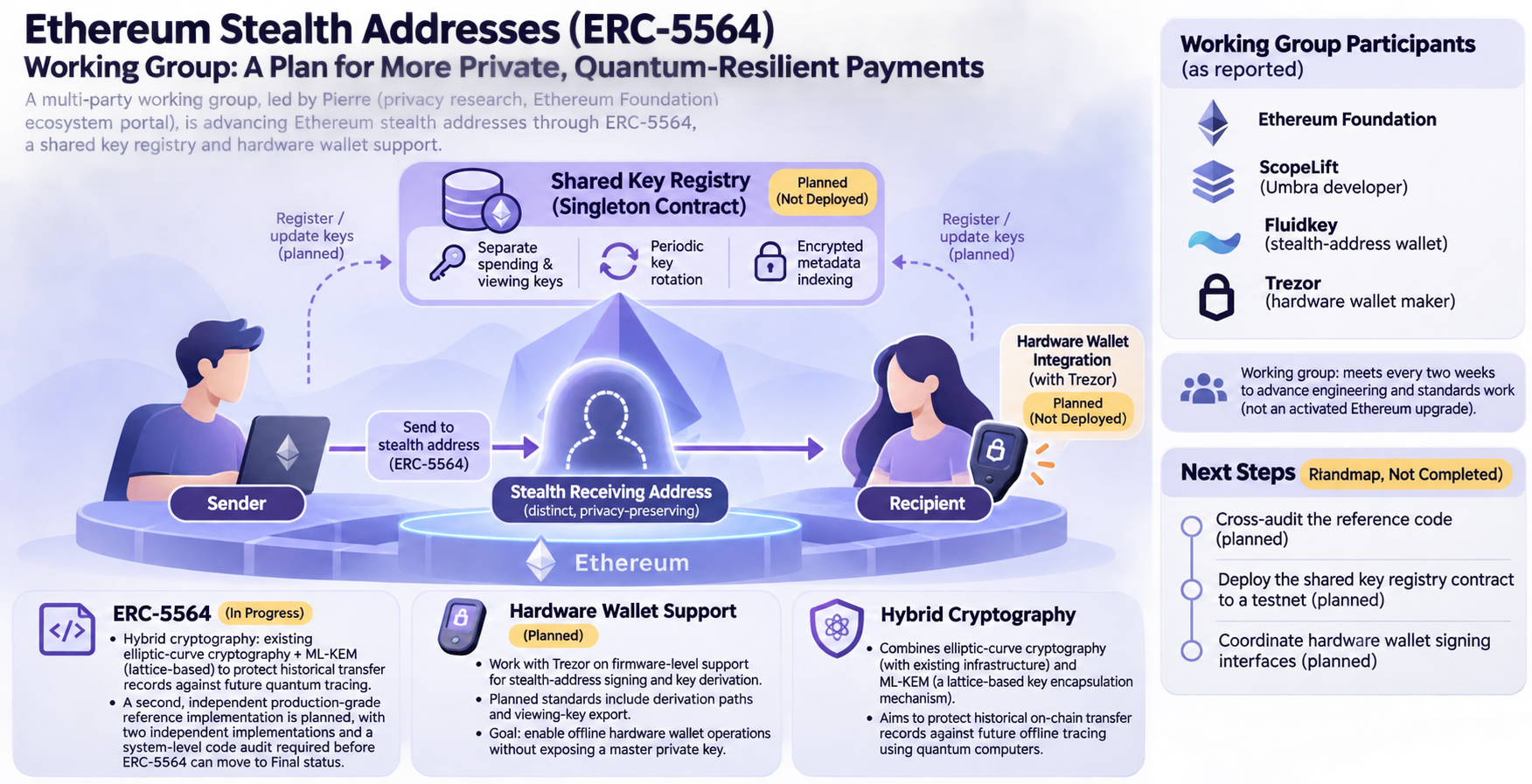
According to the working group’s website, as described in the report, participants include the Ethereum Foundation, Umbra developer ScopeLift, stealth-address wallet Fluidkey and hardware wallet maker Trezor. The group plans to meet every two weeks. Its work is planned engineering and standards work, not an activated Ethereum upgrade.
ERC-5564 and reference implementations
The group proposes a hybrid approach combining existing elliptic-curve cryptography with ML-KEM, a lattice-based key encapsulation mechanism. Its stated aim is to protect historical on-chain transfer records against future offline tracing using quantum computers.
The group also plans a second, independent production-grade reference implementation of ERC-5564. The original report describes two independent implementations and a system-level code audit as prerequisites for moving the ERC to Final status. It does not report that those steps are complete or that ERC-5564 is Final.
Shared registration and hardware wallets
To reduce the need to publish a stealth meta-address separately in each application, the group plans a singleton key registry contract on Ethereum mainnet. The proposed shared interface would support separate spending and viewing keys, periodic key rotation and encrypted metadata indexing.
The group is also working with Trezor on firmware-level support for stealth-address signing and key derivation. Planned standards cover derivation paths and viewing-key export, with the goal of enabling offline hardware wallet operations without exposing a master private key.
Next steps described in the November 18 report include cross-auditing the reference code, deploying the registry contract to a testnet and coordinating hardware wallet signing interfaces. These are roadmap items, not reported deployments or completed integrations.